
Three memoirs

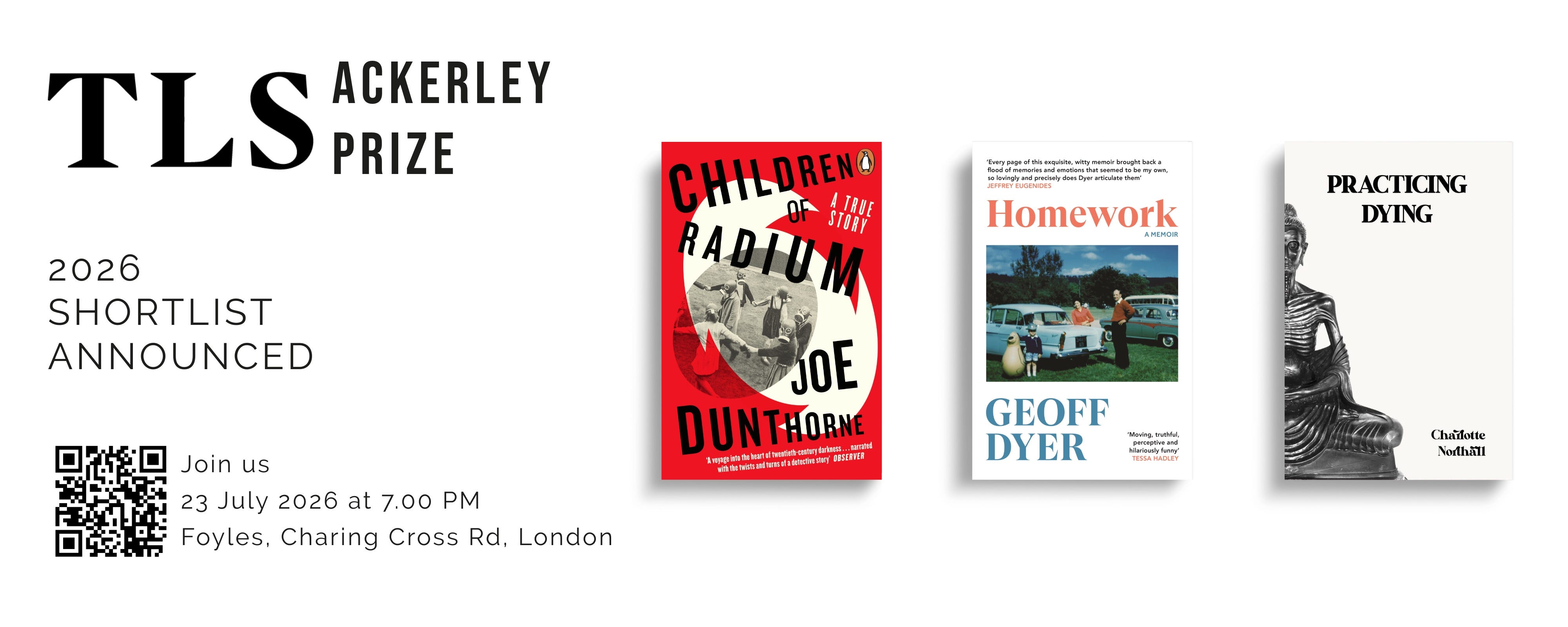
The TLS Ackerley Prize is awarded next week, on July 23; Peter Parker, chair of judges, will interview the shortlisted authors before the winner is announced. See you there if you happen to be minded to drop by Foyles . . .
Once again, as one of those judges (the third being the biographer Claire Harman), I hope we’ve made an interesting and varied selection from last year’s eligible memoirs. Thirty-one of books were called in, and six contenders for the prize eventually identified. (Others were identified as wooden-spoon-worthy, such as the one that consisted largely of semi-literate self-congratulation, padded out with illustrations.) Now here we are with a shortlist of three: Children of Radium by Joe Dunthorne, Homework by Geoff Dyer and Practicing Dying by Charlotte Northall.
Each of these memoirs excavates the past in its own distinctive and impressive way. Dunthorne goes back to the hidden history of his Jewish family in Germany. Dyer sticks to what he can recall or reconstruct of his childhood in Cheltenham Spa. Northall switches between the most desperate times in her life and a Zen Buddhist monastery in France.
The winner of the prize receives £4,000 next week, but the more important message for readers may be the line with which the Ackerley press release concludes: “We . . . urge everyone to buy and read these superb memoirs”.
Next week’s winner will be the Ackerley’s forty-sixth; the prize goes back to 1981, when it was won by Edward Blishen for Shaky Relations. Winners in the intervening years have included well-known types (Diana Athill one year, Anthony Burgess the next) and those who ought to be better known (Sonali Deraniyagala, for example, for Wave, her memoir of the Indian Ocean tsunami of 2004). They cover a “Raj childhood” (Out of India by Michael Foss), brain surgery (Do No Harm by Henry Marsh), three generations affected by war (True to Both My Selves by Katrin FitzHerbert) and a rehabilitation in Orkney (The Outrun by Amy Liptrot). The bibliophile Barry Humphries won the prize for his autobiography, More Please, in 1993, only a few years after publishing My Gorgeous Life (as Dame Edna Everage, of course).
For a collector, there’s quite an assortment of lives here to be pursued, I guess, if someone with a taste for biography fancies such a challenge. And that’s just the winners, of course. I’ve hung on to several of the other shortlisted books since becoming a judge, and several others that have stuck with me for one reason or another. It’s dangerous stuff, this life-writing, for bookshelves that are already low on space . . .
Apologies but butting in like this, but as a very inexpert Substack user I’m popping up up here to alert you to a direct message I sent which you may or may not have seen, about a recent title that might or might not be of interest.